What Is an NHS Bank Shift Calculator?
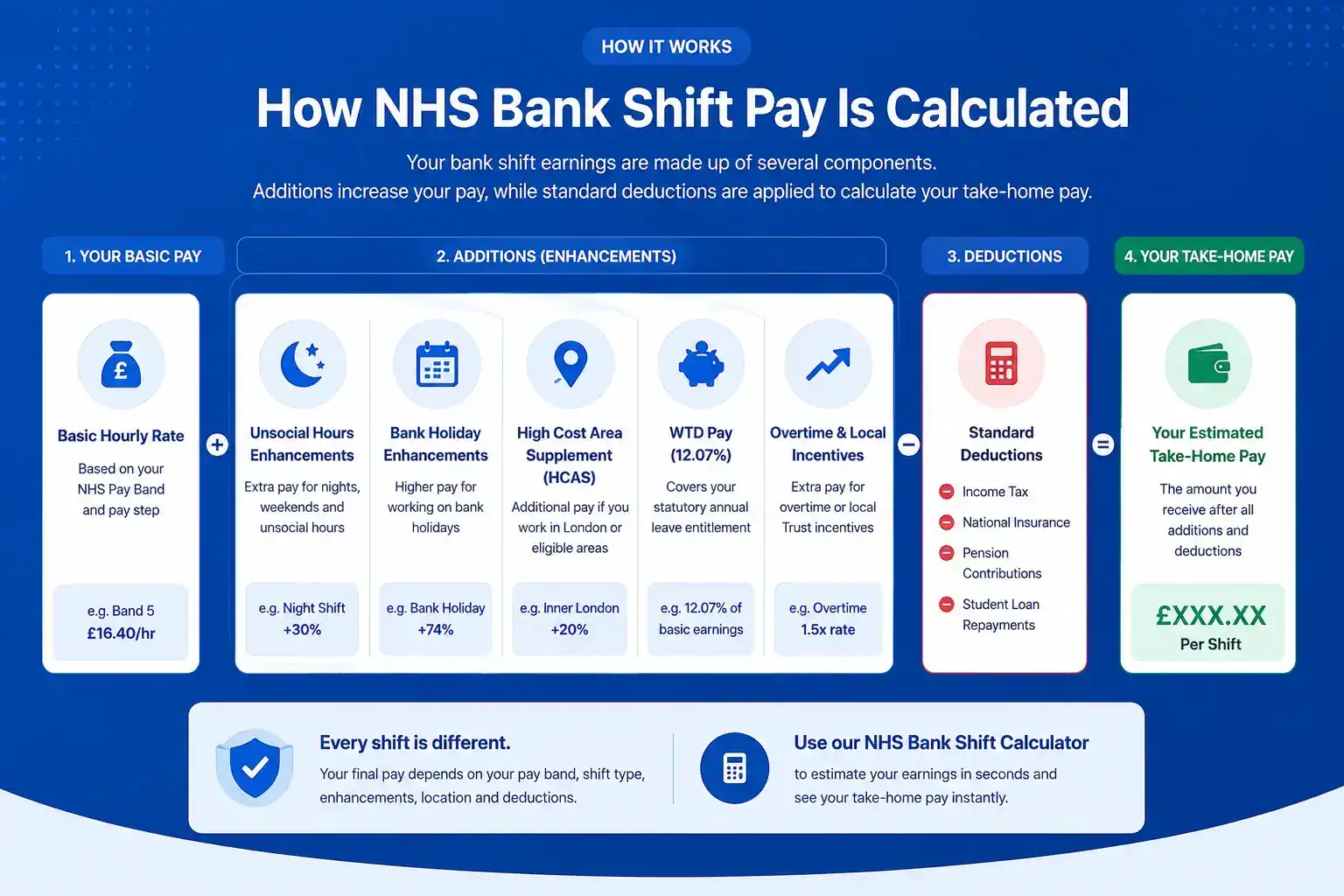
An NHS Bank Shift Calculator is an online tool that helps estimate earnings from additional bank shifts. Manual calculations can be confusing for many NHS employees, especially when unsocial hours, WTD pay, tax and pension deductions are involved.
The calculator gives an instant breakdown of your expected bank shift pay, helping staff understand how extra hours may affect overall earnings, Income Tax, National Insurance and pension contributions.
It is especially useful for NHS employees who work occasional bank shifts alongside their regular role, as well as bank-only staff who want to estimate weekly, monthly or annual earnings.
What Is a Bank Shift in the NHS?
In simple terms, a bank shift is an additional shift offered by an NHS Trust to cover short-term staffing gaps. Rather than relying only on external agency staff, many Trusts maintain an internal pool of flexible workers known as the staff bank.
These temporary shifts help cover staff sickness, annual leave, periods of high demand and unexpected increases in patient activity. As a result, bank staff play an important role in keeping services running safely.
How NHS Bank Shifts Work
An NHS bank shift is usually worked through an NHS Trust's internal staff bank rather than through an external agency. Bank workers are typically paid in line with NHS pay bands and local Trust rates.
NHS bank shifts may be available across a wide range of roles, including:
Bank Staff vs Permanent NHS Employees
Bank staff work through an NHS Trust's staff bank, while permanent staff usually have a fixed contract and guaranteed hours. Both can work alongside each other, but their terms are not always the same.
| Feature | Bank Staff | Permanent Staff |
|---|---|---|
| Contract type | Flexible, temporary | Permanent or fixed-term |
| Guaranteed hours | No | Yes |
| Shift selection | Choose available shifts | Fixed rota or schedule |
| Annual leave | Usually paid as an uplift | Paid annual leave entitlement |
| Sick pay | Limited or unavailable | NHS sick pay scheme |
| Career progression | May be limited | Structured progression |
Flexible Working and Extra Earnings
One of the main benefits of NHS bank work is the flexibility it offers. While permanent roles usually have fixed rotas, bank staff can choose when, where and how often they want to work. As a result, it can be easier to balance work with studies, family commitments or other responsibilities.
Financially, the benefits can also be significant. Staff may earn additional pay from night, evening, weekend and bank holiday shifts. Depending on your pay band, location and shift pattern, these enhancements can substantially increase overall earnings.
NHS Bank Shift Pay Rates 2026/27
NHS bank shift pay rates for 2026/27 follow the Agenda for Change (AfC) pay structure. Unlike substantive NHS roles, which are paid as an annual salary, bank shifts are paid on an hourly basis. Therefore, actual earnings can vary from shift to shift, especially if you work nights, weekends or bank holidays.
How Bank Shift Pay Is Calculated
In most cases, bank shift pay begins with your standard NHS hourly rate, which depends on your pay band and pay step.
Basic pay
Your standard hourly rate based on your NHS band and pay step.
Enhancements
Extra pay for unsocial hours, weekends and bank holidays.
Deductions
Income Tax, National Insurance, pension and student loan deductions may apply.
Bank Pay Rates by NHS Band
| NHS Band | Typical annual salary | Approx. hourly rate |
|---|---|---|
| Band 2 | £25,272 | £12.92/hr |
| Band 3 | £25,760 – £27,476 | £13.17 – £14.05/hr |
| Band 4 | from £28,392 | from £14.52/hr |
| Band 5 | £32,073 – £39,043 | £16.40 – £19.97/hr |
| Band 6 | from £39,912 | from £20.41/hr |
| Band 7 | from £49,387 | from £25.26/hr |
Factors That Affect Bank Shift Pay
Your final bank shift pay depends on your band, experience level, Trust location, whether High Cost Area Supplement (HCAS) applies, and whether the shift attracts unsocial hours enhancements. For more detailed salary comparisons, see the 2026/27 NHS Pay Scales.
NHS Night Shift Pay Rate
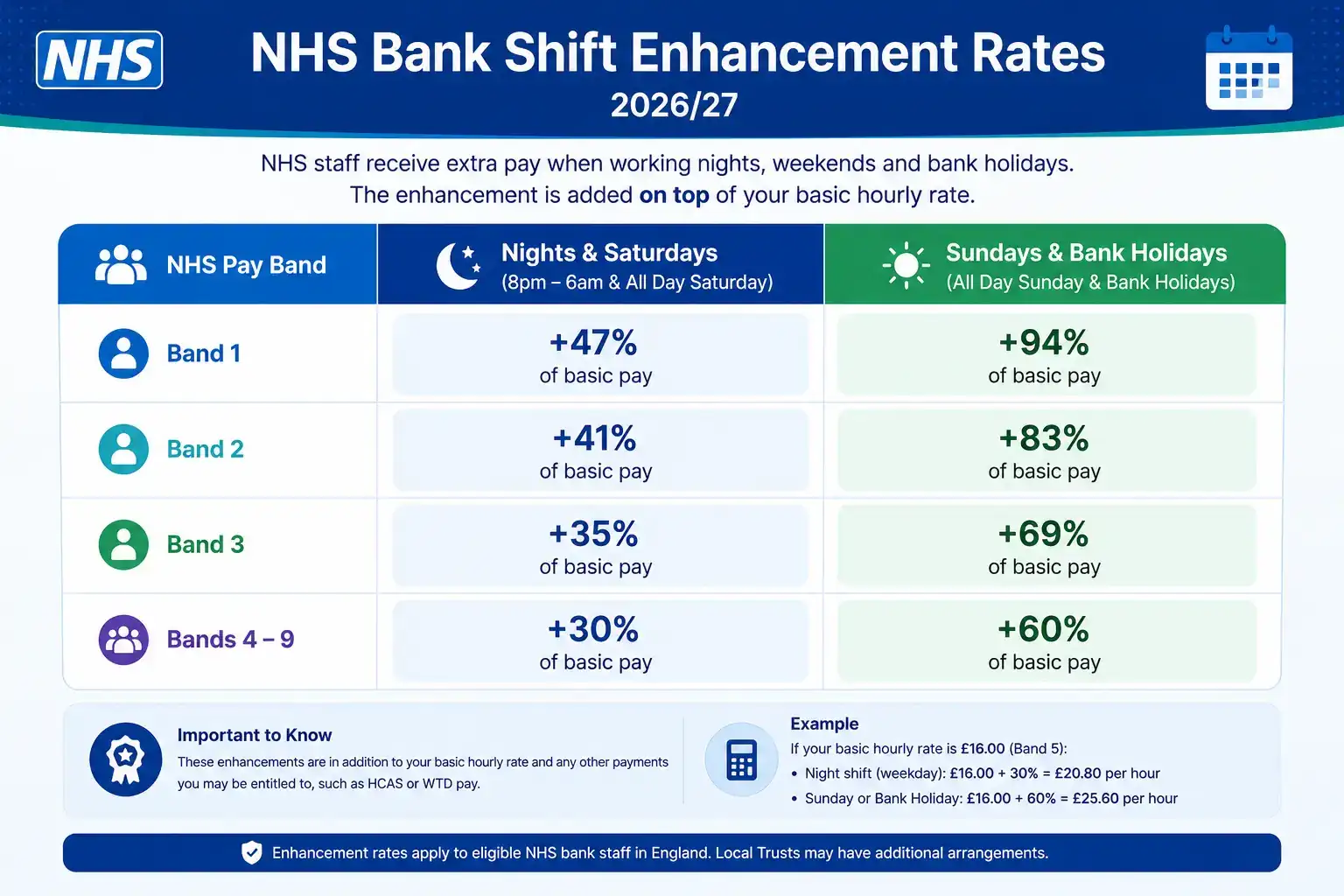
Working nights, weekends and bank holidays is one of the most effective ways for NHS staff to increase earnings. In addition to basic hourly pay, unsocial hours enhancements are added for eligible shifts.
Night Shift Enhancements
Night shift enhancements usually apply to weekday hours worked between 8:00 pm and 6:00 am.
| NHS Band | Night rate |
|---|---|
| Band 1 | Basic pay + 47% |
| Band 2 | Basic pay + 41% |
| Band 3 | Basic pay + 35% |
| Bands 4–9 | Basic pay + 30% |
Weekend Shift Enhancements
Weekend rates are usually higher than standard weekday rates. For Bands 4 to 9, Saturdays attract a 30% enhancement, while Sundays attract a 60% enhancement.
Bank Holiday Enhancements
NHS staff working on bank holidays are usually entitled to the same enhancement rates as Sunday shifts. For Bands 4 to 9, this is typically basic pay plus 60%.
NHS Bank Holiday Pay Explained
NHS employees who work on bank holidays are usually entitled to enhanced pay. For bank staff, these shifts can be particularly valuable because the enhancement is added on top of the basic hourly rate.
| NHS Band | Typical bank holiday enhancement |
|---|---|
| Band 1 | Basic pay + 94% |
| Band 2 | Basic pay + 83% |
| Band 3 | Basic pay + 69% |
| Bands 4–9 | Basic pay + 60% |
These earnings are still subject to tax, National Insurance and other deductions, so gross pay will not always match your final take-home amount.
What Is WTD Pay in the NHS?
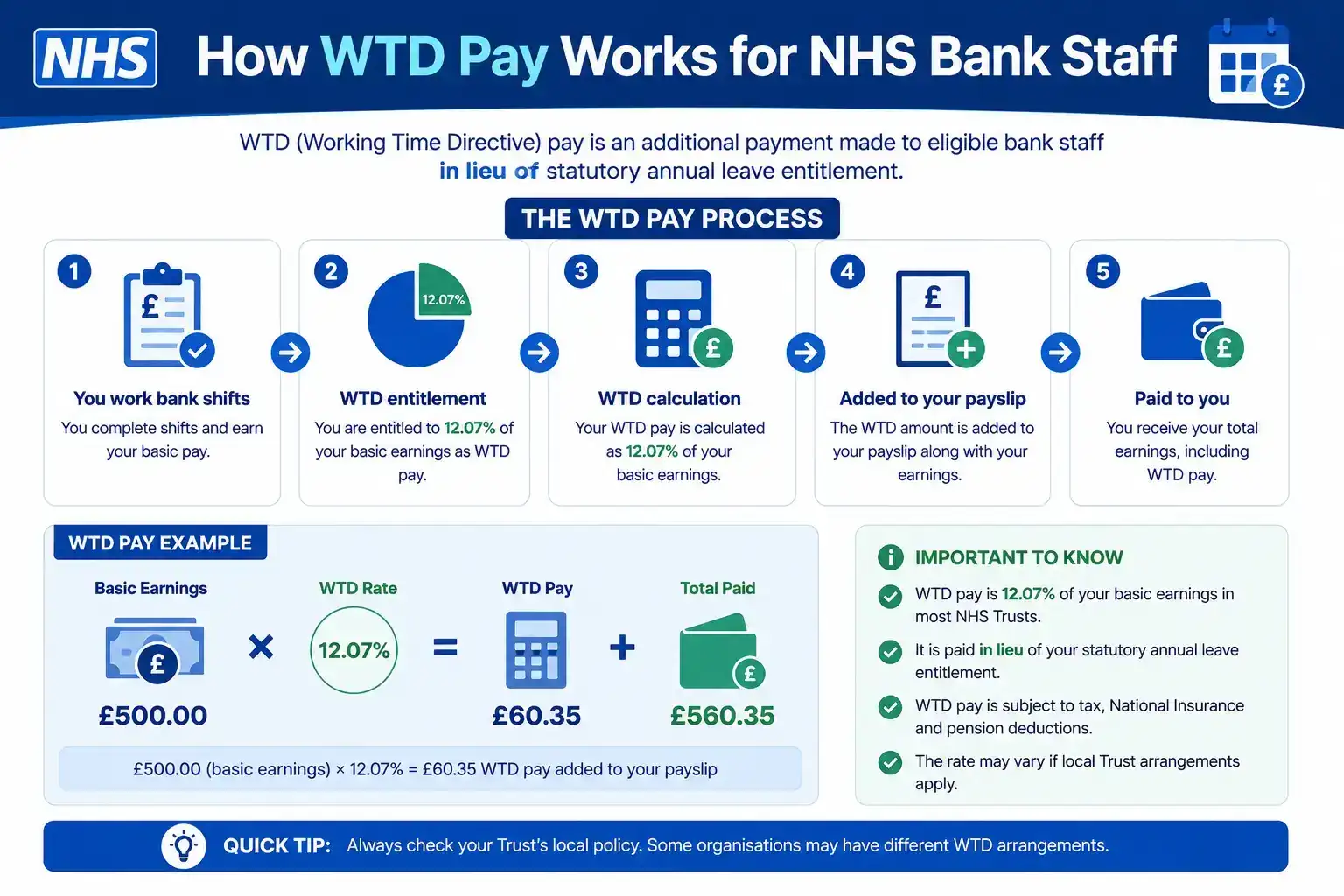
WTD stands for Working Time Directive. If you work NHS bank shifts, you may notice WTD pay on your payslip. In simple terms, WTD pay is an additional payment made to eligible bank staff to cover statutory annual leave entitlement.
What Does WTD Mean?
WTD refers to the Working Time Directive, which protects workers' rights around rest breaks, working hours and statutory annual leave.
WTD Pay NHS Explained
Because bank staff often do not take paid annual leave in the same way as substantive employees, many NHS Trusts add a percentage to bank earnings instead.
Why WTD Pay Appears on NHS Payslips
WTD pay appears as a separate line because it is usually paid in addition to basic pay and unsocial hours enhancements.
How WTD Pay Is Calculated
In many NHS Trusts, WTD pay is calculated as 12.07% of basic earnings. This percentage is based on the statutory annual leave entitlement of 5.6 weeks per year, although local arrangements can vary.
NHS Shift Patterns Explained
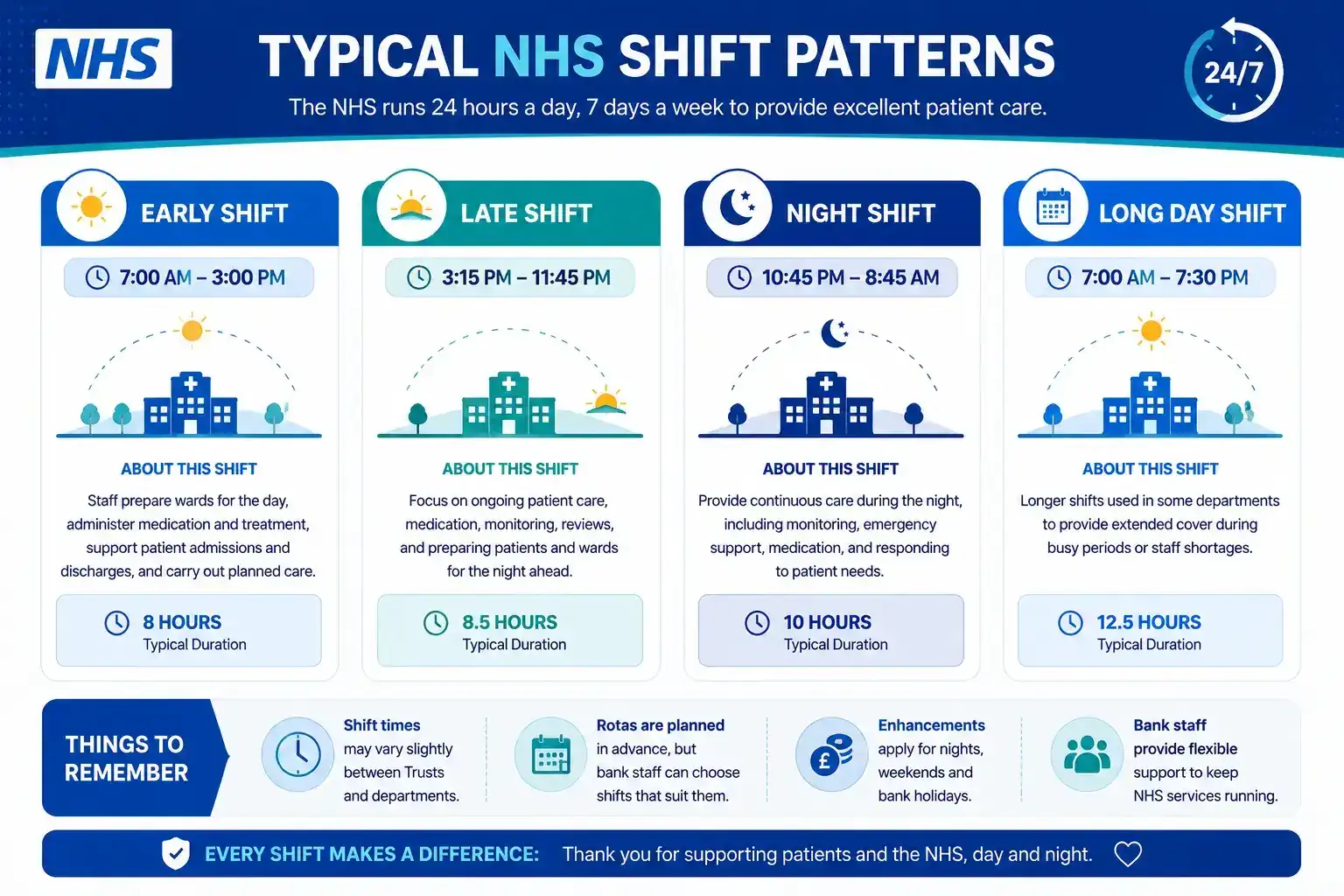
The NHS operates 24 hours a day, seven days a week. Therefore, staff work a variety of shift patterns to ensure patients receive continuous care.
Early Shifts
Usually start between 7:00 am and 8:00 am and typically last 7.5 to 8 hours.
Late Shifts
Often start in the afternoon, for example from 3:15 pm to 11:45 pm.
Night Shifts
Often cover overnight care, with common patterns such as 10:45 pm to 8:45 am.
Long-Day Shifts
Usually last between 10 and 12.5 hours and are common in clinical settings.
Rotational Shift Patterns
Many NHS workers follow rotational shift patterns rather than fixed schedules. Nurses and healthcare support workers may rotate between early, late and night shifts depending on service needs.
How Much Can You Earn From NHS Bank Shifts?
For the 2026/27 pay year, NHS bank shift rates are generally aligned with the latest Agenda for Change pay scales, which increased by 3.3% from 1 April 2026.
Example: Band 2 Bank Staff
Two additional 12-hour shifts per month at £12.92/hr could add about £3,720.96 gross per year.
Example: Band 3 Bank Staff
One extra 12-hour shift could earn between £158.04 and £168.60 before deductions.
Example: Band 5 Nurse
Three 12-hour Saturday shifts per month at entry rate could add around £9,210 gross per year.
Example: HCA Bank Shifts
Four 10-hour Band 2 night shifts with 41% enhancement could add around £8,745.60 gross per year.
How to Apply for NHS Bank Shifts
If you are an existing NHS employee or looking to work temporarily, registering for bank work is usually straightforward. Most NHS Trusts manage their own internal staff banks, while others use providers such as NHS Professionals.
How to Register for Bank Shifts NHS
First, check whether your local NHS Trust operates its own staff bank or works with an external provider. You can usually find this information through your local Trust website, NHS Jobs, NHS Professionals, staff intranet portals or Employee Online systems.
Requirements and Documents
You may need proof of identity, right-to-work documents, references, occupational health clearance, DBS checks and professional registration details where applicable.
NHS Professionals and Local Trust Banks
Some staff register directly with their NHS Trust, while others use NHS Professionals to access flexible shifts across participating organisations. The best option depends on your location, role and preferred working pattern.
Frequently Asked Questions
NHS bank shift pay depends on your band, experience level, contract type, location and the type of shift you work. Basic hourly rates in England start at around £12.92 per hour for Band 2 staff and can exceed £65 per hour for higher senior roles.
Yes, NHS bank staff usually receive enhanced pay rates for bank holiday shifts. Under Agenda for Change, Bands 4 to 9 typically receive a 60% enhancement, while Bands 2 and 3 may be eligible for higher rates.
You can apply through your NHS Trust or a provider such as NHS Professionals. The process usually involves an online form, required documents and pre-employment checks.
In some cases, yes. However, rules depend on your employment status, maternity pay and whether the shifts are with your current employer or another organisation. Always check with HR before accepting shifts.
Need Your Full NHS Take-Home Pay?
Use our NHS Pay Calculator to estimate your salary after tax, pension, National Insurance, student loan deductions and HCAS. You can also check the NHS Pay FAQs for more answers.
About the Author