What Is NHS Band 4?
NHS Band 4 is a mid-level classification within the UK's Agenda for Change (AfC) pay framework — the system that determines salaries for most NHS staff. This band sits above the support-level roles in Band 3 NHS Pay and carries more advanced responsibilities.
Band 4 typically requires a professional registration, apprenticeship, or significant relevant experience combined with a higher qualification beyond foundation skills. Various roles within this band — such as Nursing Associates, Assistant Practitioners, and Pharmacy Technicians — often need registration with the Health and Care Professions Council (HCPC) or the Nursing and Midwifery Council (NMC).
Where Does Band 4 Sit in the Agenda for Change Pay Structure?
The NHS AfC pay framework covers all nine bands from Band 1 (entry-level support) to Band 9 (most senior leadership). Band 4 sits above Bands 2 and 3, which offer support-level work, but below Band 5, which requires full professional registration. Band 4 is generally considered a senior support position — an important stepping stone towards Band 5 for staff working towards full registration.
NHS Band 4 is available across various NHS departments, including healthcare services, administration, laboratories, and community care. To compare the 2026/27 NHS Pay Scales across all bands, see our full pay scales guide.
NHS Band 4 Salary and Pay Scale 2026/27
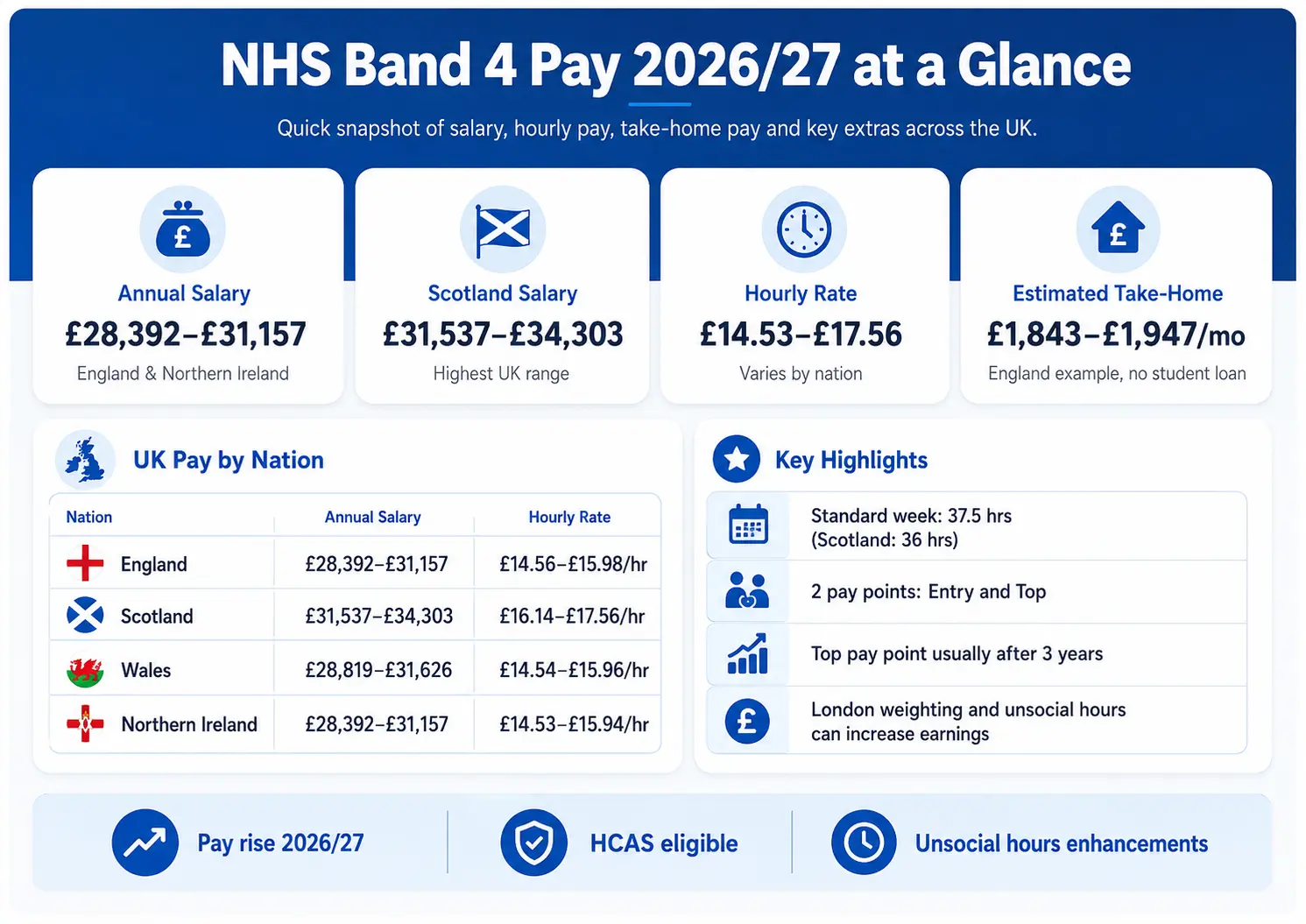
The NHS Band 4 salary 2026/27 is set under the Agenda for Change pay framework. From 1 April 2026, salaries in England, Wales, and Northern Ireland increased by 3.3%. Scotland negotiated separately and secured a higher uplift of 3.75% under a pre-agreed two-year deal — NHS Scotland staff also moved to a shorter 36-hour working week from April 2026 without any salary reduction.
NHS Band 4 Salary in England, Scotland, Wales, and Northern Ireland
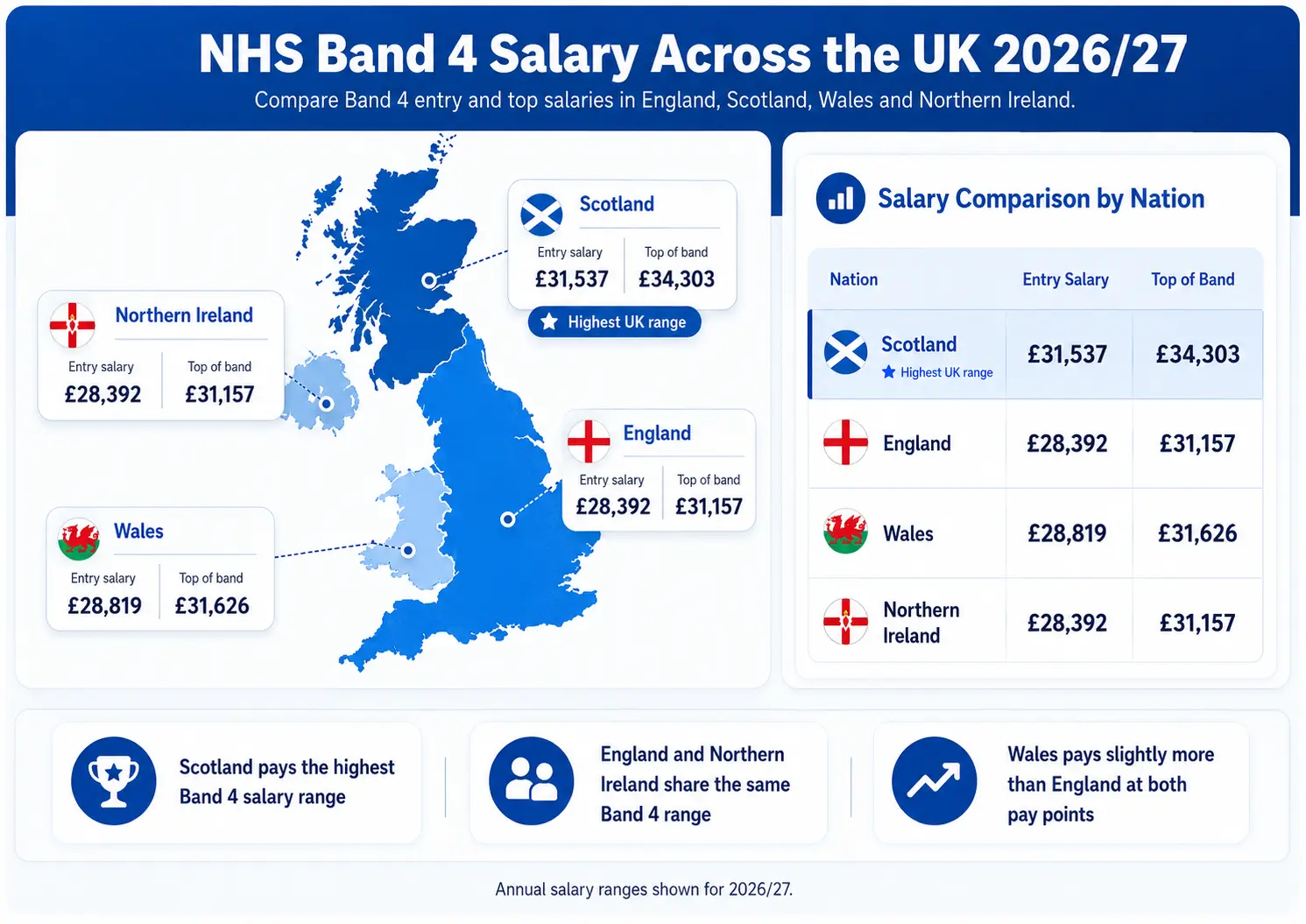
The Agenda for Change framework is UK-wide, but each nation negotiates its own pay award separately. Therefore, the same Band 4 job pays different amounts depending on your Trust location, your experience, and your length of service. Here is the complete annual salary breakdown for 2026/27 across the UK:
England
Based on official NHS Employers pay scales effective 1 April 2026. Entry point £28,392, top of band £31,157.
Scotland
Higher 3.75% award under the multi-year AfC agreement, with a 36-hour working week — the highest Band 4 pay in the UK.
Wales
Slightly higher than England, reflecting the 3.3% uplift and the long-standing Welsh premium on lower pay points.
Northern Ireland
Northern Ireland mirrors the England 3.3% award. Check HSCNI directly for the most accurate confirmation.
| Nation | Entry Salary | Top of Band |
|---|---|---|
| England | £28,392 | £31,157 |
| Scotland | £31,537 | £34,303 |
| Wales | £28,819 | £31,626 |
| Northern Ireland | £28,392 | £31,157 |
NHS Band 4 Pay Points
NHS Band 4 has just two pay points: an entry point and a top point, with no intermediate step. Employees start at the entry level and become eligible to move to the top of the band after three years of service, subject to satisfactory NHS Knowledge and Skills Framework (KSF) appraisal.
| Pay Point | Annual Salary (2026/27) |
|---|---|
| Entry Level | £28,392 |
| Top Level | £31,157 |
Progression note: The move from entry to top takes a minimum of three years of satisfactory service. Band 4 is often used as a stepping stone to Band 5 roles, which require full professional registration. For a detailed comparison between these two bands, see the Band 3 NHS Pay guide, which explains how Band 3 to Band 4 progression works.
NHS Band 4 Hourly, Weekly and Monthly Pay Across the UK
Annual salary is important for comparison, but many people also want to know what that means per hour or per month. The calculation method is simple: divide the annual salary by 52.143 weeks, then by the standard weekly hours.
1. England
England's Band 4 employees work a standard 37.5 hours per week. From 1 April 2026, NHS Band 4 salaries in England increased by 3.3% under the AfC pay framework.
- Annual salary: £28,392 to £31,157
- Monthly pay: approximately £2,366 to £2,596
- Weekly pay: approximately £546 to £599
- Hourly rate: approximately £14.56 to £15.98
2. Scotland
NHS Scotland salaries increased by 3.75% from 1 April 2026 — higher than the 3.3% increase in England. Additionally, staff work a shorter 36-hour working week from April 2026, without any reduction in salary. This means the Scottish hourly rate calculation uses 36 hours rather than 37.5:
- Annual salary: £31,537 to £34,303
- Monthly pay: approximately £2,529 to £2,751
- Weekly pay: approximately £581 to £632
- Hourly rate: approximately £16.14 to £17.56
3. Wales
NHS Band 4 pay in Wales for 2026/27 is based on a standard 37.5-hour working week, as in England:
- Annual salary: £28,819 to £31,626
- Monthly pay: approximately £2,366 to £2,596
- Weekly pay: approximately £546 to £599
- Hourly rate: approximately £14.54 to £15.96
4. Northern Ireland
NHS Band 4 staff in Northern Ireland work 37.5 hours weekly, similar to England's salary structure:
- Annual salary: £28,392 to £31,157
- Monthly pay: approximately £2,366 to £2,596
- Weekly pay: approximately £546 to £599
- Hourly rate: approximately £14.53 to £15.94
Comparison table: Band 4 hourly rate by nation
| Nation | Weekly Hours | Hourly Rate (Entry) | Hourly Rate (Top) |
|---|---|---|---|
| England | 37.5 | £14.56 | £15.98 |
| Scotland | 36 | £16.14 | £17.56 |
| Wales | 37.5 | £14.54 | £15.96 |
| Northern Ireland | 37.5 | £14.53 | £15.94 |
Quick calculation: Annual salary ÷ 52.143 ÷ 37.5 = basic hourly rate (England, Wales & Northern Ireland). For Scotland, divide by 36 instead of 37.5. To see your personalised take-home pay, use the NHS Pay Calculator.
NHS Band 4 Take-Home Pay After Deductions
NHS Band 4 take-home pay depends on several deductions: income tax, National Insurance, NHS pension contributions, and — for some staff — student loan repayments. The basic formula is:
Take-Home Pay = Gross Salary − Income Tax − National Insurance − NHS Pension − Other Deductions
Income Tax and National Insurance
For 2026/27, NHS Band 4 staff pay income tax at the basic rate of 20% above the standard personal allowance of £12,570. At the entry level, this works out to approximately £3,164 annually (around £264 per month). National Insurance is charged at 8% on earnings above £12,570 annually.
NHS Pension Contributions
The NHS pension is an occupational pension scheme with six contribution tiers ranging from 5.2% up to 12.5%, depending on salary. For 2026/27, the relevant tiers for Band 4 staff are:
| Pensionable Pay | Contribution Rate |
|---|---|
| £13,260 to £28,854 | 6.5% |
| £28,855 to £35,155 | 8.3% |
Student Loan Deductions
For 2026/27, NHS Band 4 staff with student loans have repayments deducted directly from their salary. The exact rate depends on the loan plan — Plan 1, 2, 4, or 5 — and repayments are charged at 9% of earnings above the plan threshold. The main 2026/27 thresholds are:
| Loan Plan | Repayment Threshold (2026/27) |
|---|---|
| Plan 1 | £26,900 |
| Plan 2 | £29,385 |
| Plan 4 (Scotland) | £33,795 |
| Plan 5 | £25,000 |
This matters significantly for Band 4 employees because their pay range straddles several of these thresholds. For example, a staff member at the entry salary of £28,392 on Plan 1 would make repayments (above the £26,900 threshold), but the same person on Plan 2 would not — their repayments would only start once they reached the top of the band at £31,157.
Estimated Monthly Take-Home Pay
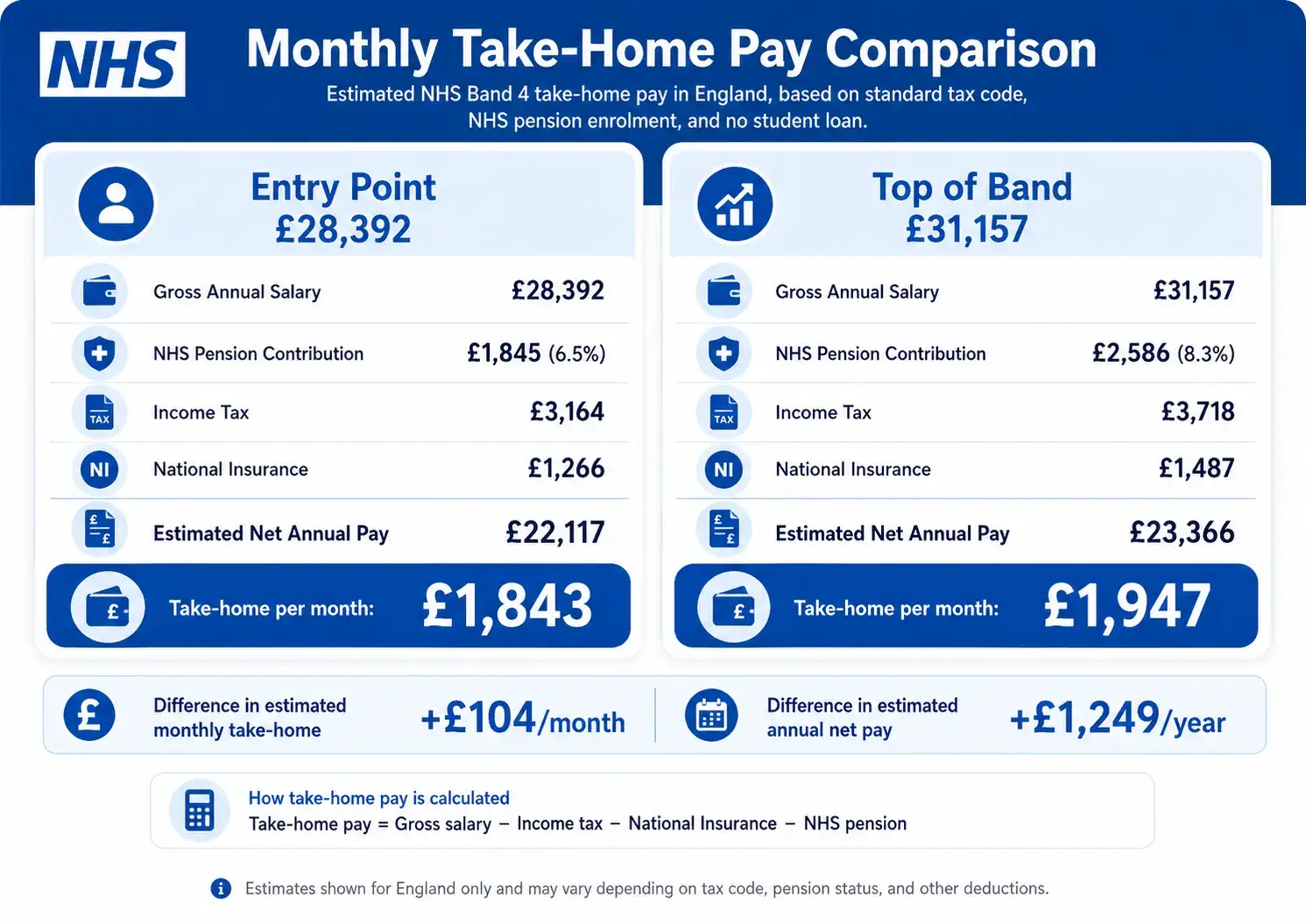
The following table shows estimated take-home pay for a Band 4 employee working in England, based on no student loan, standard tax code, and standard NHS pension enrolment:
| Category | Entry Point (£28,392) | Top of Band (£31,157) |
|---|---|---|
| Gross Annual Salary | £28,392 | £31,157 |
| NHS Pension Contribution | £1,845 (6.5%) | £2,586 (8.3%) |
| Income Tax | £3,164 | £3,718 |
| National Insurance | £1,266 | £1,487 |
| Estimated Net Annual Pay | £22,117 | £23,366 |
| Estimated Net Monthly Pay | £1,843 | £1,947 |
Income Tax
~£264/mo — 20% basic rate on earnings above the £12,570 personal allowance.
National Insurance
~£106/mo — 8% NI on earnings between £12,570 and £50,270.
NHS Pension
~£154/mo — 6.5% of pensionable pay at entry point, deducted before income tax.
Est. Take-Home
Approximate monthly take-home after all standard deductions at the entry pay point in England.
To get precise figures for your situation, use the NHS take-home pay calculator, which accounts for your specific tax code, pension tier, student loan plan, and location.
How Does HCAS Affect NHS Band 4 Salary?
The High Cost Area Supplement (HCAS) — also called London Weighting — increases NHS Band 4 pay for staff working in London and nearby areas to help offset the higher cost of living. HCAS also counts as pensionable pay, meaning Band 4 employees who are eligible contribute slightly more to their NHS pension.
HCAS rates for 2026/27 are:
Inner London
Min: £5,794 · Max: £8,746
Outer London
Min: £4,870 · Max: £6,137
Fringe Area
Min: £1,346 · Max: £2,270
If you are eligible for London Weighting, use the High Cost Area Supplement (HCAS) Calculator to estimate your total earnings with the supplement applied. With Inner London HCAS, a Band 4 entry salary of £28,392 would attract the minimum supplement of £5,794, bringing the total to approximately £34,186 before tax.
NHS Band 4 Unsocial Hours Pay Rate
NHS Band 4 staff who work unsocial hours — such as evenings, nights, weekends, or bank holidays — receive an additional enhancement payment on top of their basic hourly rate. These enhancements can significantly increase overall monthly earnings.
Band 4 employees working night shifts and Saturdays receive a 30% enhancement. Sundays and Bank Holidays attract a higher 60% enhancement, as these are considered the least sociable hours to work.
| Shift Type | Enhancement | Entry Rate | Top of Band Rate |
|---|---|---|---|
| Standard hours | None | £14.56 | £15.98 |
| Night shift | +30% | £18.93 | £20.77 |
| Saturday | +30% | £18.93 | £20.77 |
| Sunday/Bank Holiday | +60% | £23.30 | £25.57 |
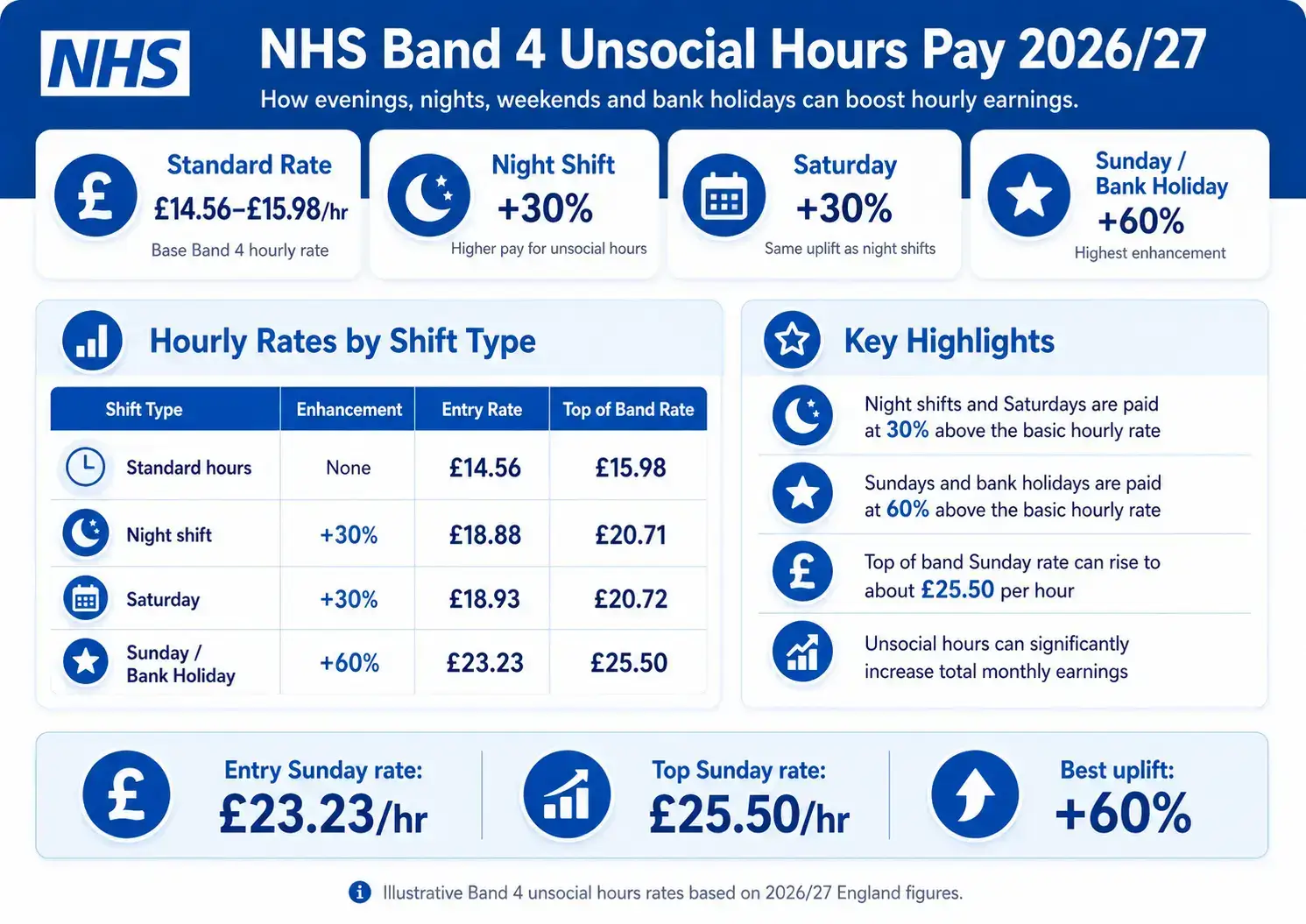
For example, a Band 4 employee at the top of the scale earning a base rate of £15.98 per hour who works a Sunday shift earns approximately £25.57 per hour — a 60% uplift. Use the Bank Shift Calculator to estimate your exact earnings from nights, weekends, and bank holidays.
What Jobs Are Paid at NHS Band 4?
NHS Band 4 provides diverse positions across technical and clinical functions. Here are the three most common roles:
Nursing Associate
A Nursing Associate serves as a bridge between healthcare assistants and registered nurses, with more clinical autonomy than a standard HCA. Key responsibilities include administering medication, performing clinical observations, and providing direct patient care under supervision.
Assistant Practitioner
Assistant Practitioners carry out clinical duties in healthcare departments under the supervision of registered professionals such as physiotherapists and radiographers. Tasks include taking blood samples, supporting diagnostic imaging, and assisting with rehabilitation programmes.
Pharmacy Technician
A Pharmacy Technician at Band 4 is responsible for the safe and effective supply of medicine to patients. Core duties include checking medicine stock levels, supplying medicines to patients, and advising on correct medicine use.
What is the Difference Between Band 3 and Band 4?
Band 3 NHS Pay roles carry fewer responsibilities — such as Healthcare Assistant and Senior Administration positions with vocational training. Band 4 roles like Pharmacy Technicians and Nursing Associates require higher qualifications, professional registration, and experience. Band 4 staff may also supervise junior colleagues, which is not typically expected at Band 3 level.
Related NHS Pay Tools
Use these tools to get a more detailed picture of your NHS earnings and pay entitlements.
NHS Pay Calculator
Calculate your exact take-home pay after tax, NI, pension and HCAS for any NHS band.
2026/27 NHS Pay Scales
View the complete Agenda for Change pay scales for all bands and pay points.
High Cost Area Supplement (HCAS) Calculator
Estimate your London Weighting supplement for Inner London, Outer London or Fringe areas.
Bank Shift Calculator
Estimate your extra earnings from bank shifts, including unsocial hours enhancements.
Band 3 NHS Pay
Compare Band 4 with Band 3 salaries, hourly rates, and take-home pay for 2026/27.
Calculate Your Band 4 Take-Home Pay
Get a personalised estimate of your monthly take-home pay after tax, National Insurance, pension and London Weighting. See exactly how much you will take home each month as a Band 4 NHS employee.
Use the NHS Pay Calculator →Frequently Asked Questions
-
Yes, NHS nurses in England, Wales, and Northern Ireland are receiving a 3.3% pay rise for the 2026/27 financial year, which went into effect on 1 April 2026. Meanwhile, nurses in Scotland are seeing a 3.75% uplift as part of a pre-agreed two-year deal.
-
Band 4 has two pay points. Staff typically progress to the top pay point after a minimum of three years, depending on their performance and local progression policies. Band 4 can serve as a stepping stone to a Band 5 position, for which full professional registration is required.
-
The easiest way to calculate NHS take-home pay is by using the NHS Pay Calculator, which calculates the exact pay for a specific band. Alternatively, you can calculate it manually using this formula:
Take-Home Pay = Gross Salary − Income Tax − National Insurance − NHS Pension Contribution − Student Loan Repayment (if applicable)
-
Band 3 NHS Pay roles carry fewer responsibilities — such as Healthcare Assistant and Senior Administration positions with vocational training. Band 4 roles like Pharmacy Technicians and Nursing Associates require higher qualifications, professional registration, and experience. Band 4 staff may also supervise junior colleagues. See the full comparison in our Band 3 NHS Pay guide.