What Is Band 3 in the NHS?
Band 3 is an entry-to-intermediate pay band tier in the NHS Agenda for Change (AfC) pay structure. This band is typically used for roles that go slightly beyond support work. These roles have more responsibility and specialist knowledge than their Band 2 counterparts.
Common NHS Band 3 roles include:
- Healthcare Assistant (HCA)
- Clinical Support Worker
- Maternity Support Worker
- Mental Health Support Worker
- Physiotherapy Assistant
- Medical Laboratory Assistant
- Administrative Assistant
Is Band 3 NHS Entry Level?
Not quite. Although it is close, Band 2 is generally considered the NHS entry point, covering roles like porters, domestic staff, and basic healthcare assistants. Band 3 falls just above it, which requires more experience, responsibility, or specialist knowledge compared to Band 2 NHS Pay.
Many people start their NHS career in Band 2, but soon move into a Band 3 position after gaining experience, relevant training, and qualifications. That said, it is also entirely possible to be hired directly into a Band 3 post if you already hold the necessary qualifications or experience. So Band 3 is not the absolute bottom rung; it is still very much an accessible starting point for anyone new to this field.
NHS Band 3 Salary 2026/27
NHS Band 3 Pay Rise 2026
The NHS 2026/27 salaries round moved faster than usual. The NHS Pay Review Body submitted its recommendation in early February 2026, and the UK government confirmed acceptance within a few days — on 12 February — making it one of the quickest turnarounds in recent years. For England, Wales, and Northern Ireland, the headline award came in at a 3.3% pay rise, applied to all Agenda for Change pay from 1 April 2026.
Scotland always negotiates separately and secured a higher uplift of 3.75%. It is part of a two-year pay deal that also includes an inflation-guaranteed protection. Moreover, Scottish NHS employees officially transitioned to a 36-hour working week on 1 April 2026 without salary deduction, which effectively boosts the hourly pay rate.
NHS Band 3 Annual Salary
Here are the complete and confirmed 2026/27 figures broken down by nation:
England
Based on official NHS Employers pay scales effective 1 April 2026. Entry point £25,760, top of band £27,476.
Wales
Sits slightly higher than England, reflecting the 3.3% uplift and the long-standing Welsh premium on lower pay points.
Scotland
Received the higher 3.75% award under the multi-year AfC agreement — notably more generous than the rest of the UK.
Northern Ireland
Northern Ireland typically mirrors the 3.3% award. Check HSCNI directly for the most accurate and up-to-date confirmation.
What Is a Band 3 Salary Per Hour?
Calculating the Band 3 hourly rate is relatively straightforward in England and Wales, since both use a standard 37.5-hour week. To work out the hourly rate, divide the annual salary by 52.143 weeks, then by 37.5 hours.
NHS England Band 3 Hourly Rate
Using the updated NHS Band 3 2026/27 pay scales, a Band 3 staff member in England earning the starting salary of £25,760 would receive approximately £13.18 per hour. Meanwhile, an employee at the top of the band earning £27,476 comes to around £14.05 per hour.
NHS Wales Band 3 Pay Per Hour
Wales uses the same standard 37.5-hour working week as England, so the hourly rate calculation method is also the same. For the 2026/27 Welsh Band 3 employee, the entry salary of £26,300 equates to around £13.46 per hour. Staff at the top of the band earning £27,890 would receive around £14.28 per hour — a higher hourly rate than England.
NHS Scotland Band 3 Hourly Rate
Scotland's hourly calculation is a little different because the standard working hours per week are shorter. From April 2026, Scottish NHS staff work a 36-hour week. A Band 3 staff member in Scotland earning the entry salary of £29,053 would receive approximately £15.51 per hour under the new 36-hour structure.
NHS Band 3 Northern Ireland Pay Per Hour
Northern Ireland generally follows the same 37.5-hour week as England and Wales. Once the 2026/27 pay is officially confirmed, Band 3 hourly rates will be calculated using the same formula: annual pay divided by 52.143 weeks, then by 37.5 hours.
Quick calculation: Annual salary ÷ 52.143 ÷ 37.5 = basic hourly rate (England & Wales). For Scotland, divide by 36 instead of 37.5. To see your personalised take-home pay, use the NHS Pay Calculator.
NHS Band 3 Wage Compared Across the UK
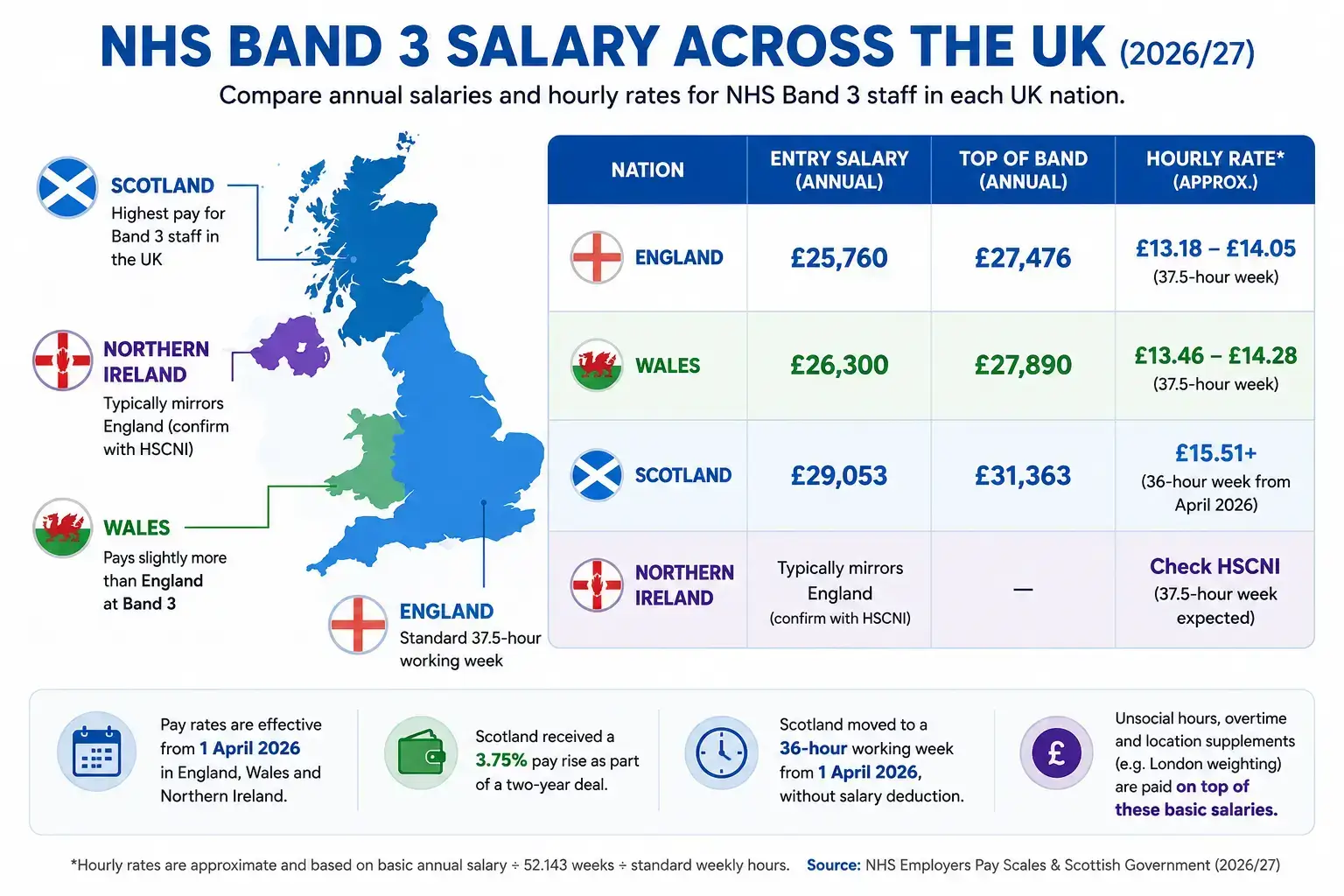
The table below compares the latest 2026/27 Band 3 salaries across UK nations to help you understand where Band 3 staff earn the most.
| Nation | Entry Salary | Top of Band | Hourly (Entry) |
|---|---|---|---|
| England | £25,760 | £27,476 | ~£13.18/hr |
| Wales | £26,300 | £27,890 | ~£13.46/hr |
| Scotland | £29,053 | £31,363 | ~£15.51/hr |
| Northern Ireland | Typically mirrors England | — | ~£13.18/hr |
NHS Band 3 Pay Scale 2026/27
Band 3 Pay Points Explained
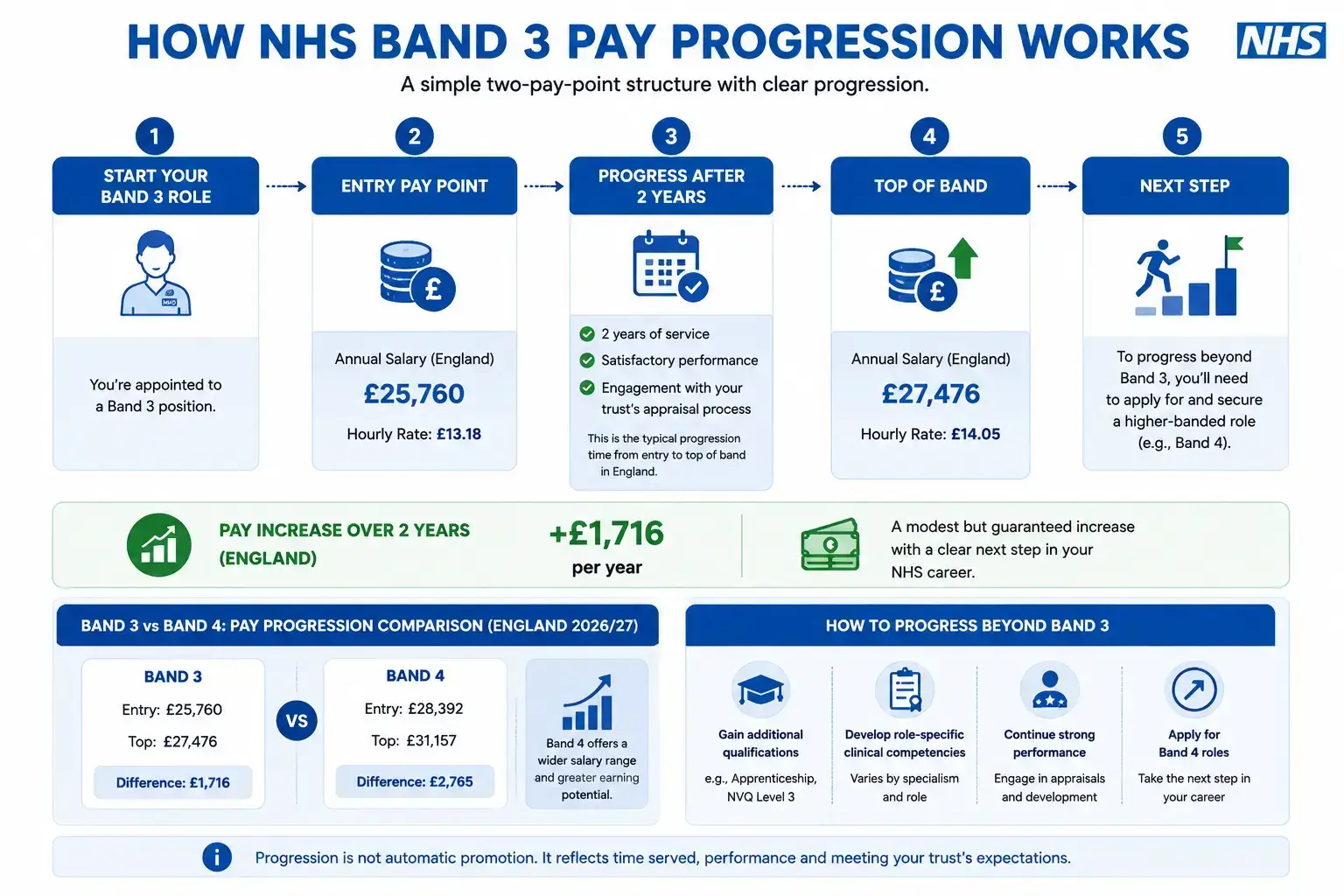
Since the 2018 pay reform, the Agenda for Change has moved away from the old system of multiple annual pay increments. Nowadays, Band 3 has a much simpler structure with just two pay points: an entry rate and a top-of-band rate.
In England, employees typically progress from the entry point to the top of the band after two years of satisfactory service. This streamlined approach is easier to understand than it used to be, but it also means the difference between entry and top pay is modest — just £1,716 a year in England for 2026/27.
Therefore, if you are thinking about your long-term earning potential, it is worth comparing Band 3 with Band 4 NHS Pay roles, where the salary progression is considerably wider.
NHS Band 3 Salary Progression
Progression through Band 3 does not mean automatic promotion. Instead, it reflects the time you have spent in your position, your satisfactory performance, and your trust's appraisal process. Under the current Agenda for Change structure, Band 3 staff members typically move from the entry pay point to the top of the band after two years of satisfactory service.
Once you have reached the top pay point, you will stay there until you apply for a Band 4 role. Band 4 often demands additional qualifications such as:
- An apprenticeship programme
- An NVQ Level 3 qualification
- Role-specific clinical competencies
- Additional professional training
As a result, investing in your professional development will open new doors to work in advanced roles within the NHS and earn higher salaries.
Band 3 Part-Time Salary Examples
If you want to work part-time, your salary will be calculated on a pro-rated basis according to your contracted hours.
22.5 hrs/week (3 days)
60% of the full-time entry salary of £25,760. Based on standard pro-rata calculation.
18.75 hrs/week (half-time)
At entry pay point — 50% of full-time. Top of band would give approximately £13,738/yr.
30 hrs/week
80% of full-time entry salary. A common choice for those balancing NHS work with other commitments.
Although NHS payroll systems calculate pro-rata salaries automatically, understanding how part-time pay works can be useful for budgeting and comparing job adverts that quote full-time equivalent (FTE) salaries.
Band 3 Take-Home Pay After Tax and Pension
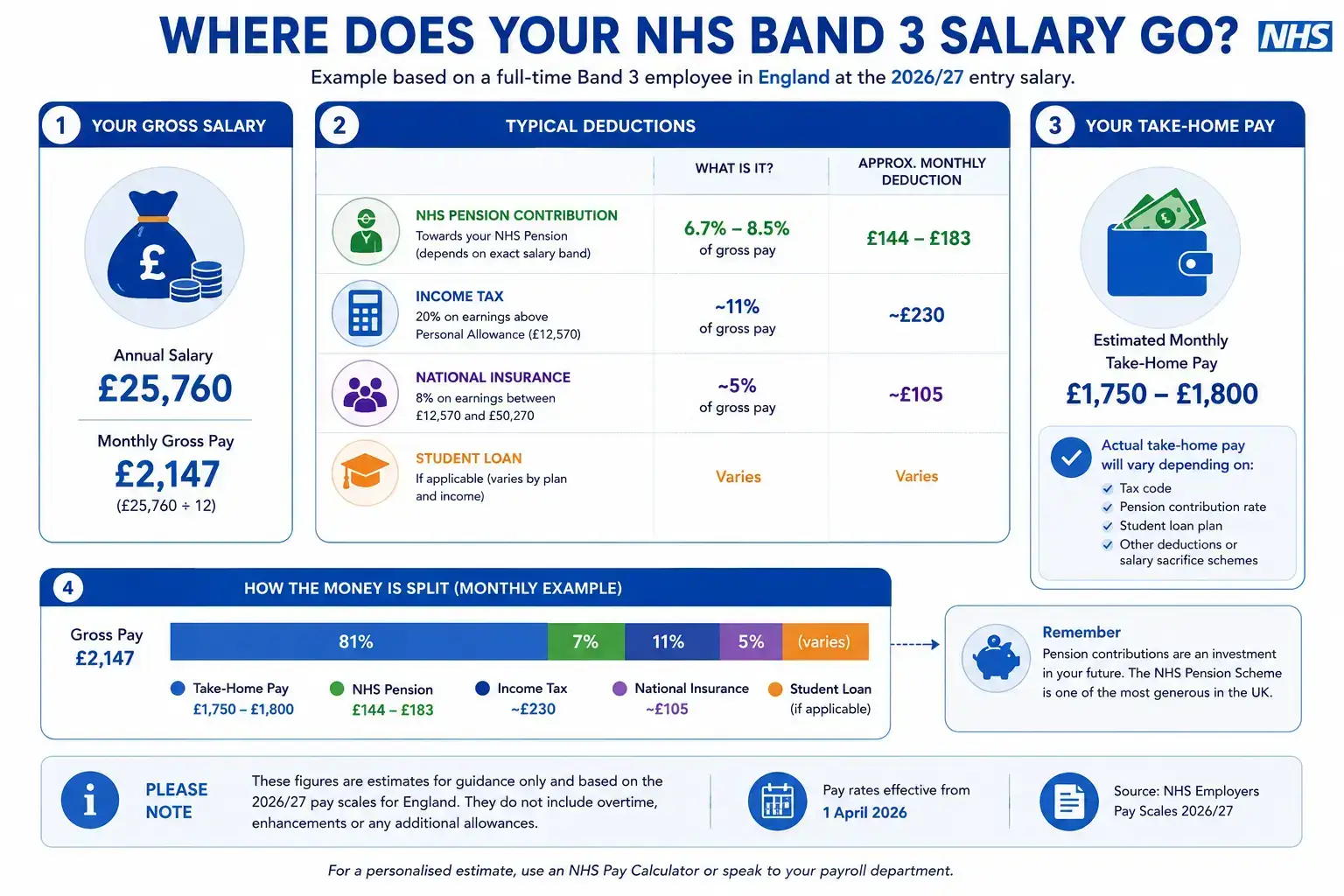
Gross salary is only part of the story. To estimate your actual take-home pay, you also need to consider Income Tax, pension contributions, National Insurance, and any other deductions.
NHS pension contributions are tiered, which means the percentage you pay depends on your salary. For Band 3 employees, contributions typically sit somewhere between 6.7% and 8.5%.
In addition, you will usually pay:
- 20% Income Tax on earnings above the personal allowance of £12,570
- 8% National Insurance on earnings between £12,570 and £50,270
- Student loan repayments, if applicable
Income Tax
~£220/mo — 20% basic rate on earnings above the £12,570 personal allowance.
National Insurance
~£88/mo — 8% NI on earnings between £12,570 and £50,270.
NHS Pension
~£144/mo — 6.7% of pensionable pay, deducted before income tax at entry point.
Est. Take-Home
Approximate monthly take-home after all standard deductions at the entry pay point in England.
Full-Time Band 3 Salary Example
Let us take the example of a Band 3 healthcare assistant in England working the standard 37.5-hour week. For the 2026/27 pay year, the starting salary is £25,760 per year. After two years of satisfactory service — assuming progression to the top pay point — the salary rises to £27,476.
Monthly Take-Home Pay Example
Breaking the entry-level salary down monthly: £25,760 per year equates to approximately £2,147 gross per month. After pension contributions (around 6.7%), Income Tax, and National Insurance, take-home pay typically lands somewhere between £1,750 and £1,800 monthly.
The exact figure will shift depending on your tax code, student loans, and pension arrangement. For a more personalised estimate, use the NHS Pay Calculator to see how different deductions affect your monthly income.
Overtime, Nights and Weekend Enhancements
Band 3 staff can benefit from some of the most generous unsocial hours enhancements available under the Agenda for Change framework. Lower pay bands are protected with higher percentage uplifts than employees in higher bands.
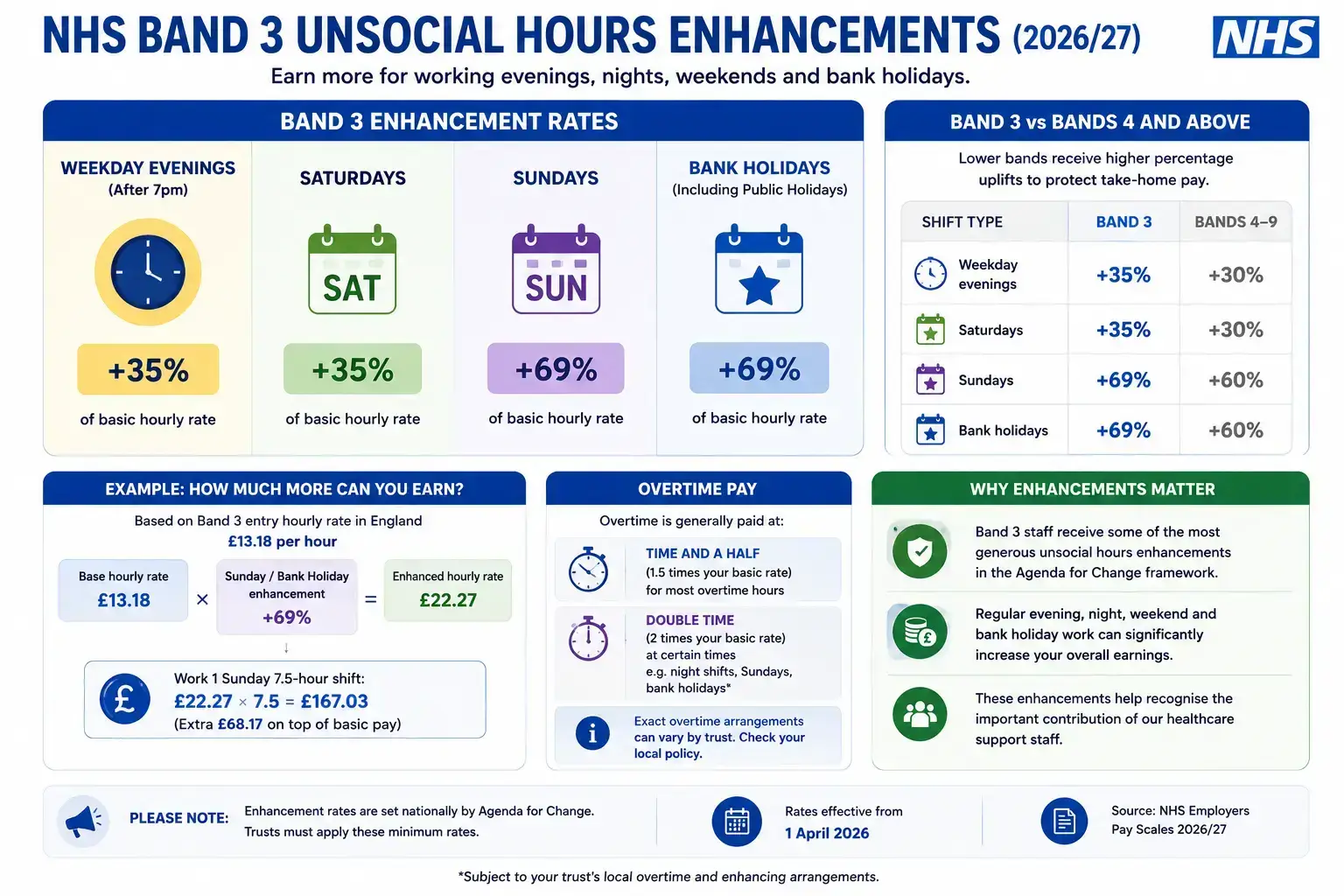
For 2026/27, Band 3 enhancement rates are:
- 35% extra for weekday evenings and Saturday shifts
- 69% extra for Sundays and public holidays
These enhancements are added to your basic hourly rate and can substantially increase your monthly earnings if you regularly work evenings, weekends, or bank holidays. Use the NHS Bank Shift Calculator to estimate your exact shift earnings.
High Cost Area Supplement (HCAS)
If your Trust is in or around London, you may also qualify for the High Cost Area Supplement (HCAS). For 2026/27, the supplement rates are:
Inner London
Min: £5,794 · Max: £8,746
Outer London
Min: £4,870 · Max: £6,137
Fringe Area
Min: £1,346 · Max: £2,270
Inner London payments are subject to a minimum payment of £5,794 and a maximum of £8,746 per year. For example, a Band 3 employee earning the entry salary of £25,760 would normally receive an additional £5,152 based on the 20% HCAS rate. However, because this figure falls below the minimum threshold, the employee would instead receive the minimum HCAS payment of £5,794.
If you are eligible for London Weighting, use the High Cost Area Supplement (HCAS) Calculator to estimate your total earnings more precisely.
Related NHS Pay Tools
Use these tools to get a more detailed picture of your NHS earnings and pay entitlements.
NHS Pay Calculator
Calculate your exact take-home pay after tax, NI, pension and HCAS for any NHS band.
2026/27 NHS Pay Scales
View the complete Agenda for Change pay scales for all bands and pay points.
HCAS Calculator
Estimate your High Cost Area Supplement for Inner London, Outer London or Fringe areas.
Band 2 NHS Pay
Compare Band 3 salaries with the full Band 2 salary guide for 2026/27.
Bank Shift Calculator
Estimate your extra earnings from bank shifts including unsocial hours enhancements.
Calculate Your Band 3 Take-Home Pay
Get a personalised estimate of your monthly take-home pay after tax, National Insurance, pension and London Weighting. See exactly how much you will take home each month as a Band 3 NHS employee.
Use the NHS Pay Calculator →Frequently Asked Questions
-
In England for the 2026/27 pay year, NHS Band 3 salaries range from £25,760 at the entry pay point to £27,476 at the top of the band. Wales pays slightly higher (£26,300 to £27,890). Scotland currently offers the highest Band 3 pay, with the range sitting at £29,053 to £31,363. Northern Ireland typically mirrors England, though confirmation timing may differ — check HSCNI directly for the latest figures.
-
In England and Wales, NHS Band 3 employees earn between £13.18 and £14.05 per hour, based on a 37.5-hour working week. Scotland moved to a 36-hour week from April 2026, which pushes the effective hourly rate higher — to around £15.51 per hour at the entry point.
-
Band 3 is a pay band within the NHS Agenda for Change (AfC) framework. It sits above Band 2 and typically covers roles requiring delegated clinical tasks, more specialist knowledge, or complex administrative duties. Common Band 3 roles include Healthcare Assistants, Clinical Support Workers, and Physiotherapy Assistants.
-
Not exactly, although it is close to entry level. Band 2 is generally considered the true NHS entry point, with many staff progressing into Band 3 once they have gained additional qualifications or skills. That said, direct entry into Band 3 is entirely possible if you already hold relevant experience or training.
-
Common Band 3 roles include:
- Healthcare Assistant (HCA)
- Clinical Support Worker
- Administrative Assistant
- Physiotherapy Assistant
- Medical Laboratory Assistant
- Maternity Support Worker
- Mental Health Support Worker
-
For England, Wales, and Northern Ireland, the 2026/27 pay award is 3.3%, effective from 1 April 2026. Scotland negotiated separately and secured a higher uplift of 3.75% as part of a two-year deal, which also included the transition to a 36-hour working week from April 2026.
-
Yes. Band 3 staff working within London or surrounding fringe areas are eligible for the High Cost Area Supplement (HCAS). The rates for 2026/27 are 20% for Inner London, 15% for Outer London, and 5% for fringe areas — all subject to minimum and maximum payment thresholds. Use the HCAS Calculator to estimate your supplement.